
What is Lease-to-Own in the Solar Industry?
Lease-to-own is a solar financing arrangement where a customer pays for the use of a solar power system through regular installments, with the goal of owning the system after completing the agreed payments.
For SUNGROW ENERGY, this can be an attractive business model because customers can install solar panels without paying the entire project cost upfront, while your company receives payments over time.
Unlike a typical Power Purchase Agreement (PPA), where the customer pays for electricity generated, a lease-to-own arrangement focuses on financing the solar equipment and transferring ownership according to the contract.
1. How lease-to-own works
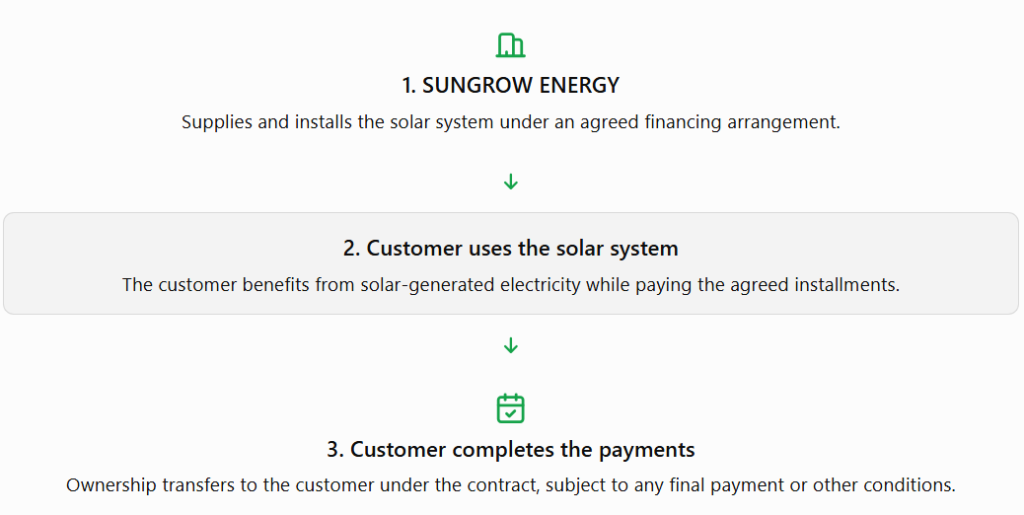
The exact structure matters: some contracts transfer ownership automatically after the final installment, while others require a buyout payment or a separate transfer document.
2. Example: Lease-to-own solar package
Suppose SUNGROW ENERGY offers a 10 kW hybrid solar system to a homeowner or small business.
These figures are illustrative, not a market quotation.
| Item | Example |
|---|---|
| Total solar system price | ₱500,000 |
| Initial down payment | ₱50,000 |
| Remaining balance | ₱450,000 |
| Payment period | 60 months |
| Monthly installment, before interest | ₱7,500 |
| Total paid over 5 years | ₱500,000 |
In this example, the customer pays ₱50,000 upfront and ₱7,500 per month for 60 months. The total payment is ₱500,000, excluding any additional fees or interest.
After satisfying the contract, the customer owns the solar system, provided the agreement specifies that ownership transfers at that point.
3. Example of a five-year lease-to-own business
Consider a 10 kW solar package sold for ₱500,000, with a ₱50,000 down payment and 60 monthly installments of ₱7,500.
Customer payment structure
₱50,000
Initial down payment
₱7,500
Monthly installment
₱500,000
Total contractual payments over 5 years
This is the customer’s payment total, not SUNGROW ENERGY’s profit. Your actual profit depends on equipment costs, labor, installation expenses, financing costs, maintenance obligations, taxes, and payment defaults.